◂▸
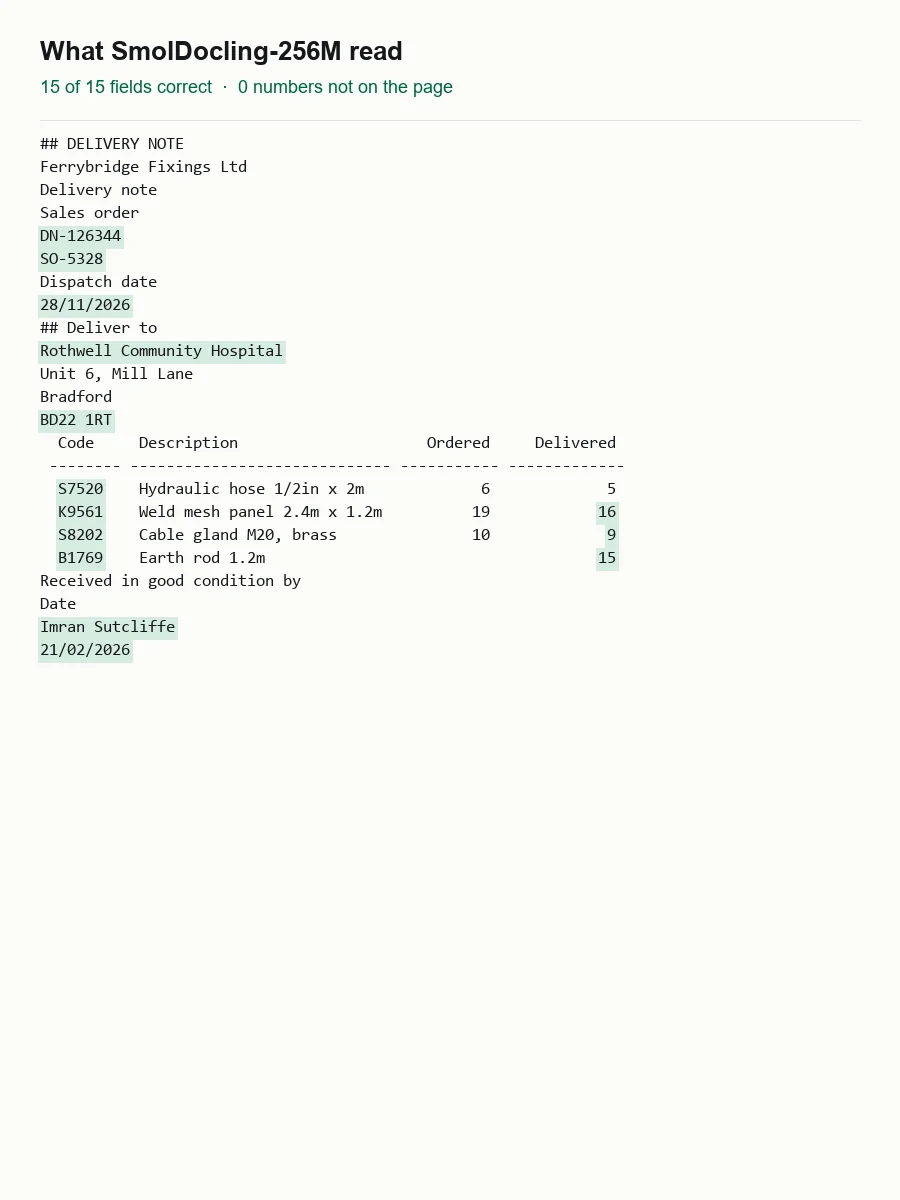
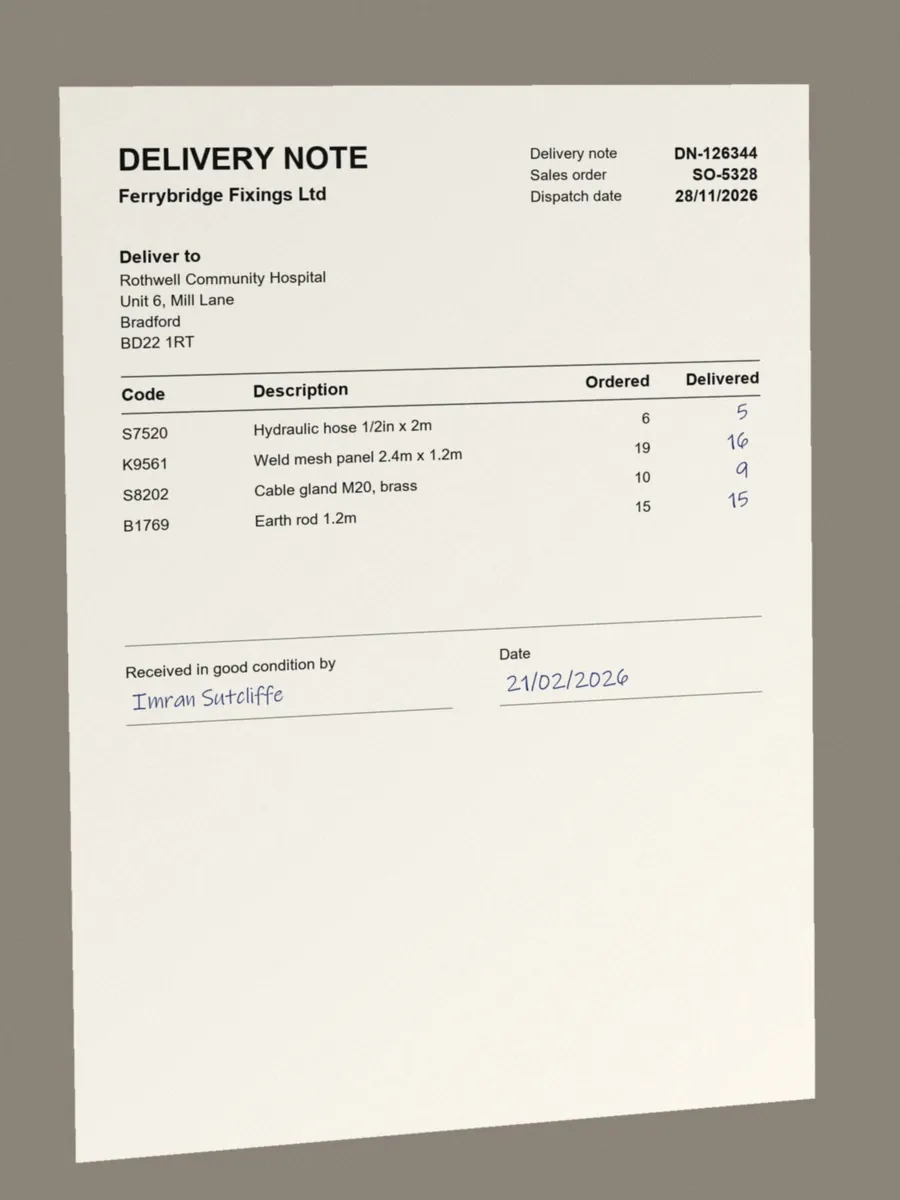
We generated 30 realistic but fictional UK documents (invoices, delivery notes and inspection forms with handwritten entries), each as a flat scan, a phone photo or a rough photo. Then we ran two small open document models locally and checked every field, and every number they wrote that isn't on the page.
What we tried
- Generated 30 fictional documents with 426 known fields, 139 of them handwritten, in three capture conditions.
- Ran each model the way its own model card shows: one call per page, greedy decoding, on a local RTX 4070.
- Scored every field by exact value, and counted every 3+ digit number in the output that appears nowhere on the page.
- Looked at every failure by eye before trusting the numbers.
What we measured
| Measure | TeleOCR (1.4B) | SmolDocling (256M) | Note |
|---|---|---|---|
| Fields read correctly | 69.5% | 90.4% | 426 fields on 30 pages |
| Handwritten fields | 90.6% | 93.5% | TeleOCR reaches 94.7% on the pages where it didn't loop |
| Numbers not on the page, per page | 16.8 | 0.17 | |
| Pages where output ran away | 6 of 30 | 2 of 30 | Repeated lines, or layout coordinates instead of text |
| Median time per page | 17.0 s | 48.4 s | |
| Peak GPU memory | 3.2 GB | 0.9 GB |
What went wrong
- On one invoice TeleOCR switched into a layout mode and wrote 501 box coordinates instead of the text. Every one of its "invented numbers" on that page is a coordinate.
- On five other pages TeleOCR repeated a line, such as the subtotal, until it hit the length limit.
- TeleOCR also drops quantity cells from tables, so its typed-field score is low even on good pages.
- Our first loader treated TeleOCR as a standard Qwen2.5-VL model. It isn't: its text layers use Qwen3-style attention, so it only loads through its own model code.
What happens next
- PaddleOCR-VL-1.6 once PyTorch is upgraded, and a loop guard (length cap, repetition check, retry) for TeleOCR.
- Real, redacted paperwork from a partner, with their permission.
- Field extraction into a spreadsheet, with a confidence flag on anything a person should check.
Built with
- SmolDocling-256M-preview CDLA-permissive-2.0
- TeleOCR Apache-2.0
- docling-core MIT
- Hugging Face Transformers Apache-2.0
Next experiment
Flat video turned into 3D live, on one graphics card →
Want this for your data?