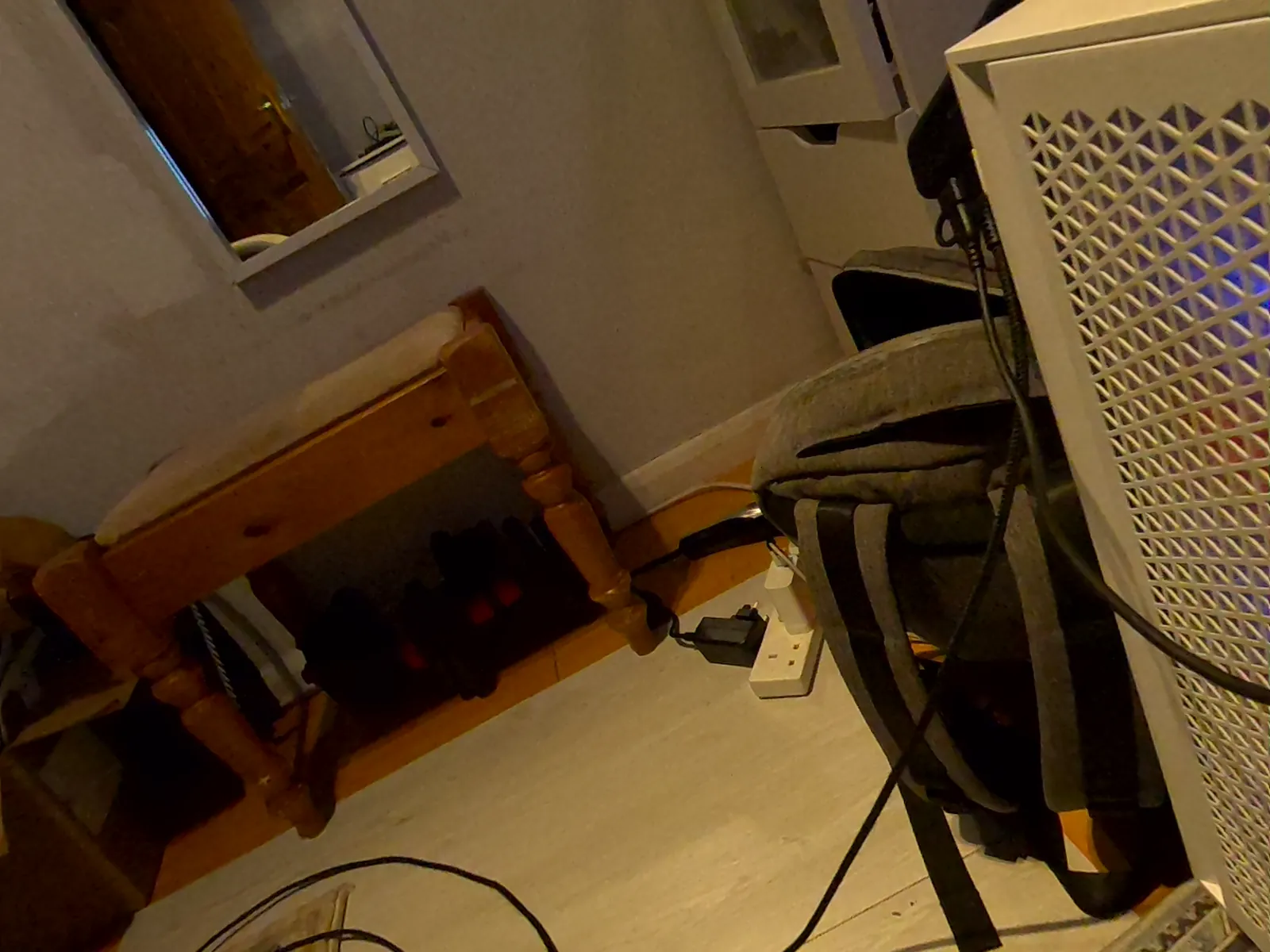
We walked a room for under three minutes wearing a Meta Quest 3, recording its passthrough cameras, depth sensor and head tracking with an open-source capture app. Because the headset already knows where it is, we skipped the usual camera solve: depth fusion refined the headset's own poses, and a Gaussian splat trained locally in 16 minutes. The room comes back in real metres with the floor at zero, so it can be stood in again at true scale in VR.
What we measured
| Measure | Result | Note |
|---|---|---|
| Capture | 167 s, 492 frames per eye | about 2.9 frames per second, 1280 × 1280 |
| Head path walked | 38.2 m | |
| Conversion (CPU) | 9.6 min | Colour, depth fusion and pose refinement |
| Training (RTX 4070) | 16 min | 30,000 steps |
| Held-out quality | 26.9 dB PSNR, SSIM 0.85 | 124 frames never used in training (every 8th) |
| Gaussians | 656,789 | |
| Download | 10.9 MB | SOG, from a 163 MB PLY |
| Head track vs camera path | 7 cm median | independent check that the poses agree |
What happens next
- Capture at 10 frames a second with QuestRealityCapture and compare.
- Try learned stereo depth (FoundationStereo) for cleaner geometry.
- Walk the same path in Meta's Hyperscape and our splat, and report what we can measure.
- Capture a car, a garden and an outdoor walk to find the limits of 3 m depth.

Get the book today: learn Gaussian splatting and apply it to real projects.
People keep asking how we build what you see here. The book walks students, educators and practitioners from a drone clip to a measured 3D in the browser, with hands-on labs and the code.
Launch price until 3 December.
Teaching a course (Level 5, Level 6 and up)? Email junaid.malik@simamdigital.com about a class discount.