How big is a Gaussian splat? What our real 3D scenes weigh, and what that means on a phone
We read the size and Gaussian count of every 3D scene on our public heritage demos. Compressed for the web they all land at 13.7 to 14.9 bytes per Gaussian, which works out 17 to 18 times smaller than the standard training file. Here are the numbers, where the bytes go, and how to pick a size a phone can open.
The short answer
Compressed for the web, with full colour detail, a Gaussian splat scene costs about 14 bytes per Gaussian (13.7 to 14.9 across our eleven scenes). One million Gaussians is about 14 MB, two million about 28 MB, three million about 42 MB. The file that training produces is far bigger: 248 bytes per Gaussian, so the same three-million scene starts life at about 744 MB. Compression is what makes a splat practical on the web at all.
What our real scenes weigh
These are the 3D scenes behind our public heritage demos, read straight from the files the site serves. Each one was captured from drone footage of a real place and keeps full colour detail.
| Scene | Gaussians | Web file | Bytes per Gaussian | Raw (computed) | Smaller by |
|---|---|---|---|---|---|
| Ortaköy, Istanbul | 1M | 13.6 MB | 13.7 | 248 MB | 18x |
| Çamlıca, Istanbul | 1.09M | 16.3 MB | 14.9 | 271 MB | 17x |
| Süleymaniye, Istanbul | 1.34M | 20.0 MB | 14.9 | 333 MB | 17x |
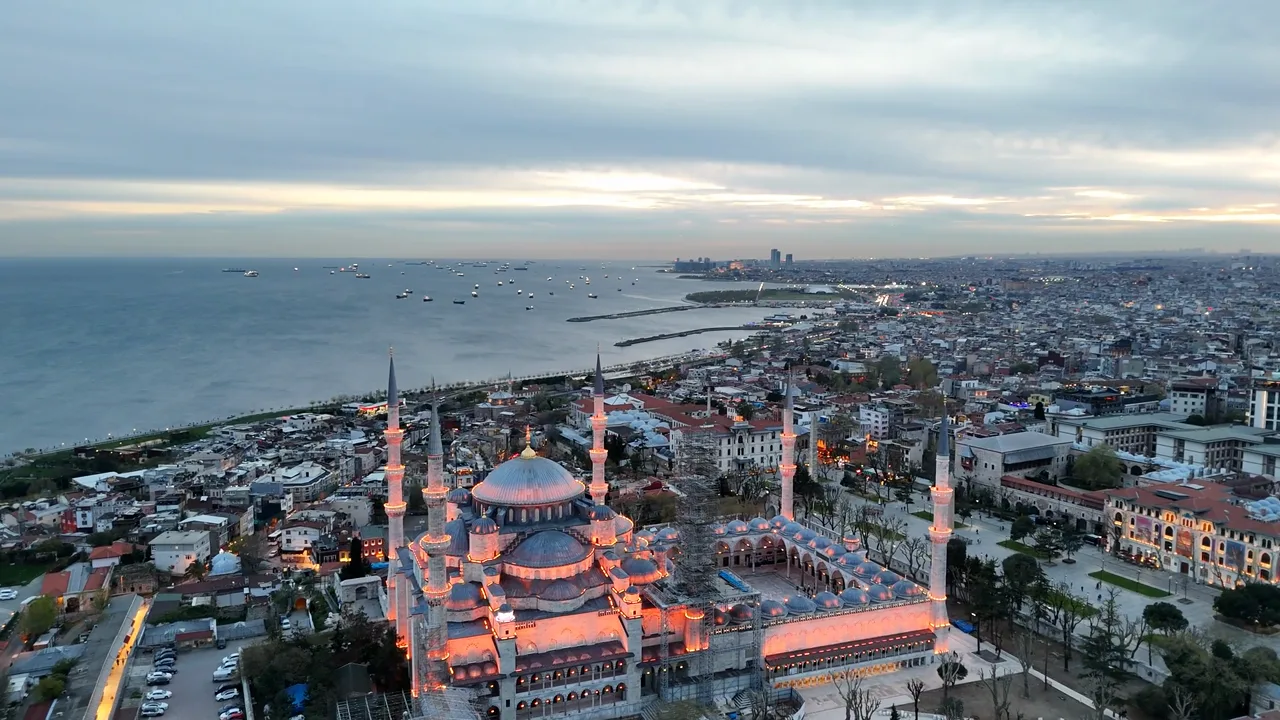
| Blue Mosque, Istanbul | 1.45M | 21.3 MB | 14.7 | 360 MB | 17x |
| Hagia Sophia, Istanbul | 1.53M | 22.2 MB | 14.5 | 379 MB | 17x |
| Wakefield, one of two parts | 1.5M | 21.1 MB | 14.1 | 372 MB | 18x |
| Scarborough | 2M | 28.0 MB | 14.0 | 496 MB | 18x |
| Cromer | 2M | 28.5 MB | 14.3 | 496 MB | 17x |
| Doonagore | 2M | 28.2 MB | 14.1 | 496 MB | 18x |
| Galata, Istanbul | 3M | 41.4 MB | 13.8 | 744 MB | 18x |
| Rock of Cashel | 3M | 42.2 MB | 14.1 | 744 MB | 18x |
The striking thing is how steady the ratio is. Across all eleven scenes, from a waterfront village to a cliff-top castle, the web file costs between 13.7 and 14.9 bytes per Gaussian. Size follows the number of Gaussians almost exactly, whatever the place looks like. That makes the Gaussian count the one number to agree before a capture.
Where the bytes go
Every Gaussian stores a position, a rotation, a size in three directions, an opacity, a base colour, and extra colour terms that let its shade change as you move round it, which is what makes glass, water and polished stone look right. Those extra colour terms are most of the raw file: 45 of its 62 numbers. Web formats squeeze all of it, but they cost something even compressed. On our factory scene, keeping the full set of colour terms instead of a reduced one took the file from 13.0 MB to 14.0 MB, about 7%, for a difference most people only notice on shiny surfaces.
What that means on a phone
On a fast line size barely matters: from our own broadband, the 13.6 MB Ortaköy scene arrived in 1.4 seconds and the 41.4 MB Galata scene in 1.8. On a phone it matters twice. First the download: at 5 Mbit/s, a weak indoor or busy-network speed, 14 MB takes about 22 seconds and 42 MB over a minute, before anything is drawn. Then memory: the phone has to hold and sort every Gaussian on every frame, so a scene that loads fine on a laptop can stutter or close on a mid-range phone. Both costs grow with the Gaussian count, which is why the count should be fixed first and the scene tested on an ordinary phone, not a flagship.
Our own scenes fall into three sizes: about one to one and a half million Gaussians for a single building, two million for a coastline or a castle with its cliffs, and three million only for a large, intricate place like Galata or the Rock of Cashel. Where a phone on a weak connection matters most, we stream the scene in stages so something appears in about a second; our streaming note has those measurements.
Five numbers to put in a brief
- The Gaussian count for each scene, agreed before capture. It sets the size almost exactly.
- The web format and the target file size: roughly 14 MB per million Gaussians with full colour.
- The time to a first 3D view on a 5 Mbit/s phone connection, not on office broadband.
- The oldest phone it must run on, and a test on that phone before launch.
- How files are named and cached, so an updated scene replaces the old one for every visitor.
What it costs to build and host is a separate question, answered on the company site: how much a WebXR project costs in 2026, and streaming splats with adaptive bitrate.
Questions people ask
How big is a Gaussian splat file?
Compressed for the web, about 14 MB per million Gaussians with full colour. Our public scenes run from 13.6 MB to 42.2 MB. Straight out of training, the same scenes are 17 to 18 times bigger.
How many Gaussians does a scene need?
It depends on the size and detail of the place. Our scenes use one to one and a half million for a single building, two million for a coastline or a castle with its cliffs, and three million for a large, intricate site.
Can you make a splat smaller without losing quality?
Mostly by using fewer Gaussians and a good web format. Trimming the extra colour terms saves about 7% and is rarely noticed except on shiny surfaces. Below a certain count the scene visibly thins out, which is why we stream a small version first rather than ship only a small version.
Do Gaussian splats work in a phone browser?
Yes, in an ordinary mobile browser with no app, as long as the scene is sized for the phone and tested on the oldest one it has to support. Try ours, or if you have a scene that is too heavy, get started now.
The size of a 3D scene decides whether a customer on a phone sees it or gives up. Knowing what a scene of a given detail actually weighs lets you set a budget in a brief, before anything is captured, instead of discovering the problem at launch.
- - Gaussian counts and file sizes read from the eleven 3D scenes behind our public heritage demos on 23 November 2026, plus the four versions of our streamed factory scene.
- - Download times for two of those scenes measured on the live site the same day.
- - Raw sizes are computed, not measured: the standard training output stores 62 numbers of 4 bytes for each Gaussian.