Can a 3D scene load fast on an ordinary phone connection? What we measured streaming Gaussian splats
A Gaussian splat scene is usually one large file, so nothing shows until it has all arrived. We cut one into a quality ladder and streamed it like video: the first 3D view in half a second instead of 5.6. Here is what we measured, what it costs, and what to ask before you put 3D in front of customers on mobile.
The short answer
Yes, if the scene is sent in stages. Sent as one file, a 1M-Gaussian scene of 14 MB took 5.6 seconds to appear on a 20 Mbit/s connection and about 22 seconds on 5 Mbit/s. Cut into a ladder of four versions and streamed like video, the first 3D view appeared in 0.5 seconds on 20 Mbit/s and 1.9 seconds on 5 Mbit/s, then sharpened while the viewer looked around. The price is that the first versions are visibly rough, and that a viewer who climbs the whole ladder downloads more in total than the single file.
Why splat scenes are slow to open
A Gaussian splat scene is made of hundreds of thousands to millions of small coloured blobs. Most web viewers fetch the whole file before drawing anything, so the visitor stares at a loading bar for as long as the download takes. The files are not small. These are the 3D files shipped with some of our own public demos, and how long they take to arrive at three common speeds:
| Demo | 3D files | 2 Mbit/s | 5 Mbit/s | 20 Mbit/s |
|---|---|---|---|---|
| Ortaköy, Istanbul | 13.6 MB | 55 s | 22 s | 5.5 s |
| Scarborough | 28.0 MB | 112 s | 45 s | 11 s |
| Galata, Istanbul | 41.4 MB | 2.8 min | 66 s | 17 s |
| Istanbul's great mosques (five places) | 79.7 MB | 5.3 min | 2.1 min | 32 s |
At 20 Mbit/s, a good home or 4G connection, even the larger scenes arrive in well under a minute. At 2 to 5 Mbit/s, which is what a phone often gets indoors, on a busy network or abroad, the same scenes take one to five minutes. Nobody waits that long for a link they were sent.
What we did: a quality ladder, like video
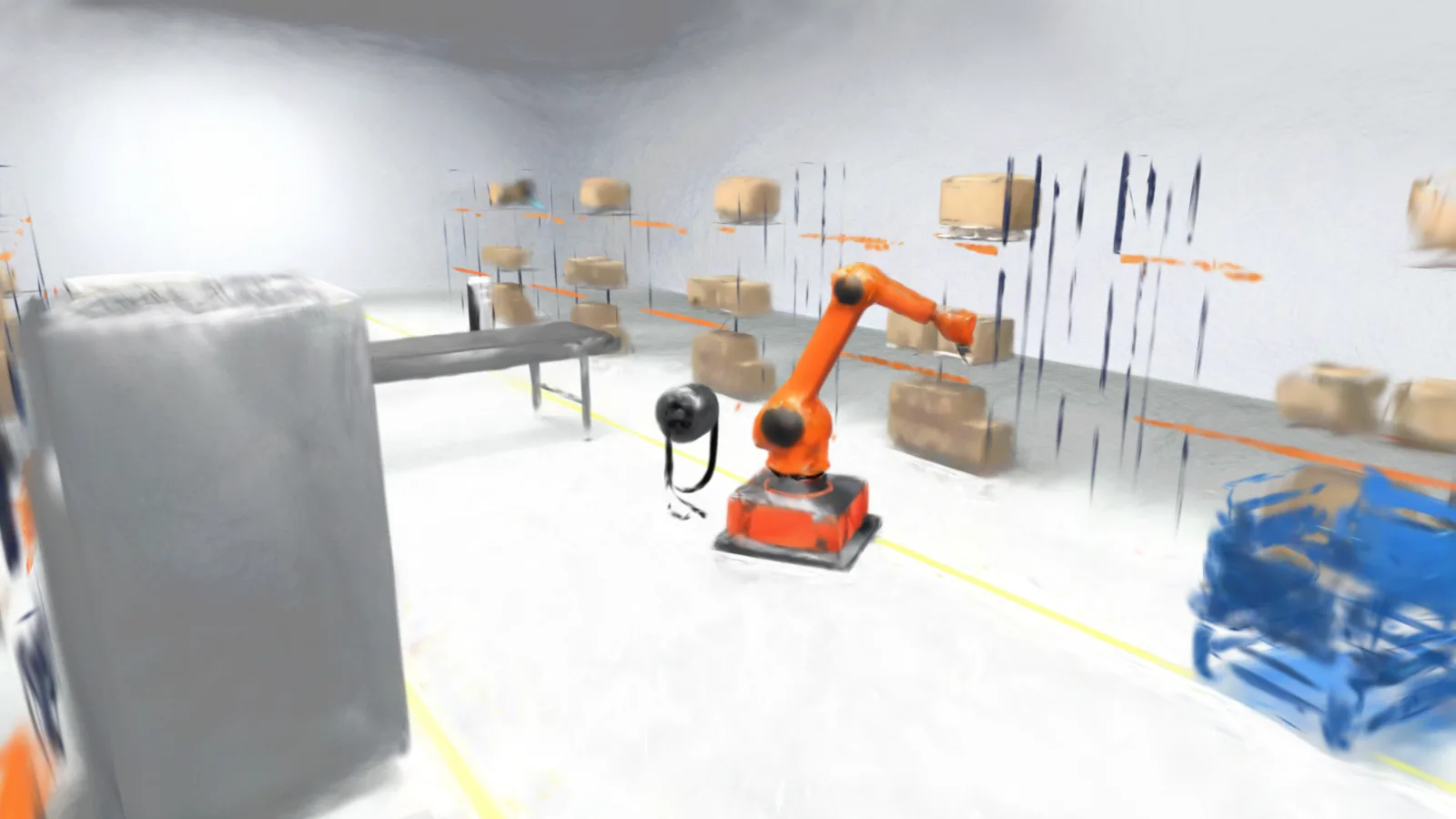
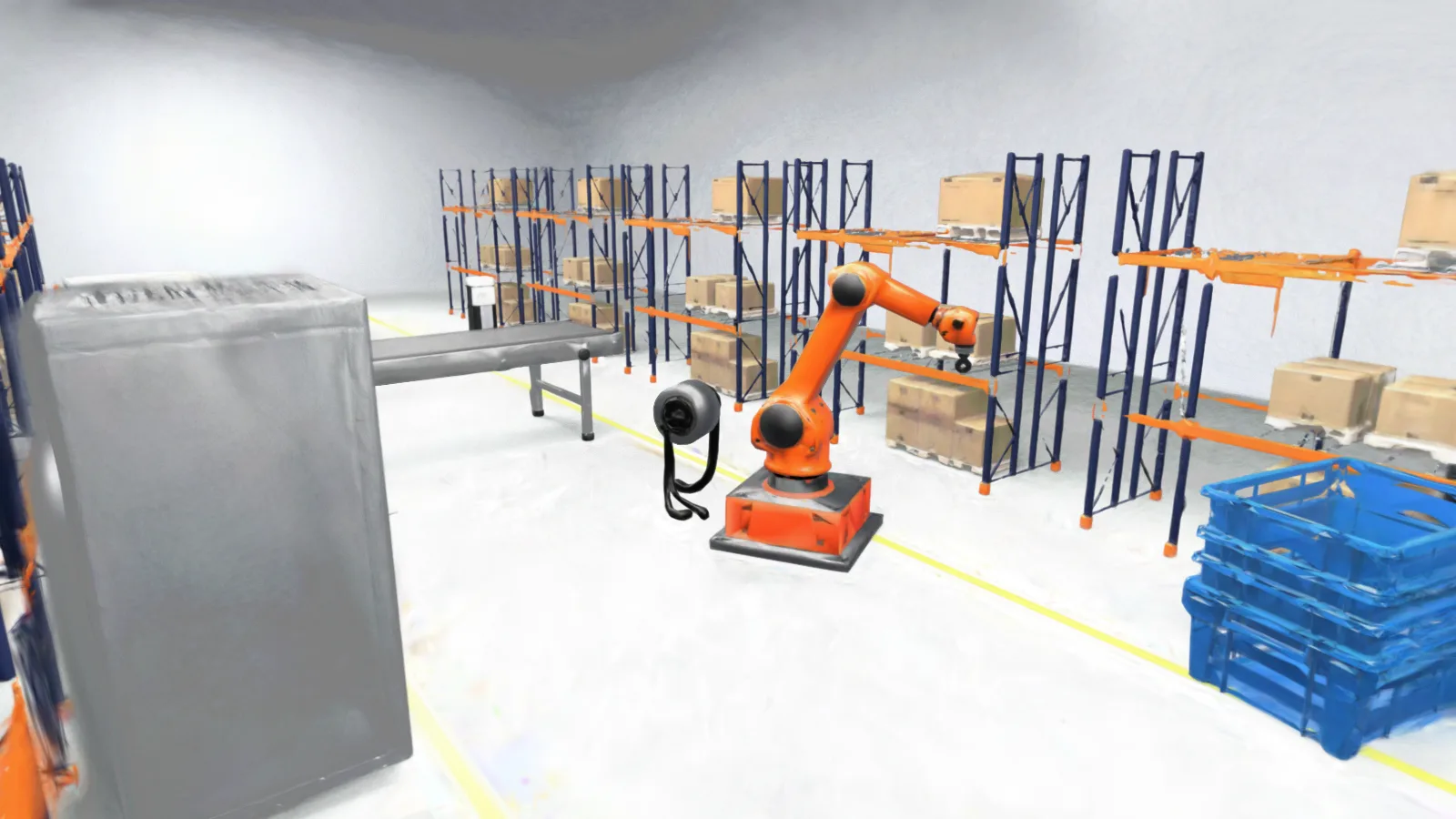
Video streaming solved this years ago. The service keeps several versions of each stretch of video at different quality, starts with a small one and steps up as the connection allows. We did the same with a 3D scene: our own rendered factory robot cell of one million Gaussians, cut into four versions.
| Version | Gaussians | Size | What you see |
|---|---|---|---|
| T0 | 100,000 | 1.2 MB | Sparse and soft: enough to see the room |
| T1 | 300,000 | 3.3 MB | Shelving and machines filled in |
| T2 | 1,000,000 | 13.0 MB | Near full detail, simpler colour |
| T3 | 1,000,000 | 14.0 MB | The full scene |
The browser loads the smallest version at once, times how fast it arrived, then fetches the largest next version it expects to arrive within about five seconds, and swaps it in. A small file listing the versions, like a video stream's manifest, tells the viewer what exists.
What we measured
| Measure | Download the whole file | Stream the ladder |
|---|---|---|
| First 3D view at 20 Mbit/s | 5.6 s | 0.5 s |
| First 3D view at 5 Mbit/s | about 22 s | 1.9 s, settling on the 300,000-Gaussian version at 7.4 s |
| Match to the full scene, T0 / T1 / T2 | n/a | 13.9 / 19.7 / 35.1 dB |
| Full colour detail | n/a | costs about 1 MB more (T2 to T3) |
We also timed the ladder on the live site on 23 November, from our own broadband line in Wakefield. One run, so treat it as a sanity check, not a benchmark: the first version arrived complete in 0.54 seconds and the full scene in 4.3 seconds. That matches the simulated results closely.
What it costs
- The first views are rough. At 13.9 dB the smallest version is clearly not the finished scene. It is there to put something real on screen fast, not to replace the full scene. For a property or heritage scene that is fine; for anything that will be measured from, wait for the full version.
- More data in total. Each version replaces the last rather than adding to it. A viewer who climbs every step downloads about 31.6 MB against 14.0 MB for the full file alone (computed from the file sizes). A ladder where each step adds Gaussians to the last would remove that waste, and it is our next step.
- More to host. Four versions instead of one, plus a manifest. The extra storage is small next to the full file, and each version caches on a content network like any other file.
What about moving 3D?
Everything above is a still scene. Moving scenes (4D Gaussian splats, a 3D scene that changes over time) are much larger, and recent research is attacking the same problem. PD-4DGS (May 2026) splits a moving scene into three layers sent one after another: a static scaffold, the overall movement, then fine detail, so that whatever has arrived can already be drawn. On the Dycheck iPhone benchmark its authors report the first frame in about 1.7 seconds on a 2 Mbit/s link, against 73 to 930 seconds for the whole-file methods they compare with, and over 60% less data streamed at matched quality. SHIN (November 2026) does the same for still scenes in a way that fixes our ladder's main waste: one reusable base with enhancement layers that add to it, so each step up extends what has already arrived instead of replacing it. Its authors report the best quality for size in every comparison they ran, across three benchmarks. Both are the authors' own results on their own data, not ours, and neither has been independently repeated that we know of. We have a moving factory clip in 3D already (our 4D playback demo), and putting it on a ladder is on our list.
Five questions to ask before you put 3D in front of customers
- How long until the first 3D view on a 5 Mbit/s phone connection, not on office broadband?
- How big is the full scene, and is it compressed for the web, or the raw training output?
- Does the viewer show something early and improve it, or hold a loading bar until the end?
- Is the scene served from a content network close to your visitors, with long caching and versioned files?
- Has it been tested on a mid-range phone, where memory, not download speed, is often the limit?
Questions people ask
How big is a Gaussian splat file?
Compressed for the web, our single scenes run from about 14 MB to about 40 MB, and a demo with several places can ship 80 MB in total. Raw training output is often several times larger before compression.
Can Gaussian splats stream like video?
Yes, in stages. Ours shows a first view from a 1.2 MB version and steps up to the full 14 MB scene. True frame-by-frame streaming of moving splats is still a research topic.
Do Gaussian splats work on phones?
Yes, in an ordinary mobile browser with no app. Download time and phone memory are the limits, which is why streaming and compression matter more than the renderer.
What we are doing next
- A ladder where each step adds Gaussians instead of replacing the last, so the total download stops growing.
- The same ladder on one of our own drone captures, not only a rendered scene.
- Moving splats on the ladder, starting with our 4D factory clip.
How the same idea runs in production, with standard video streaming formats, is covered on the company site: Gaussian splat streaming with DASH and adaptive bitrate.
Watch it stream: throttle the connection in the demo and see it adapt. If you have a 3D scene that is too slow to open, get started now.
- Our splat streaming result (EXP-056) ↗
- Watch it stream: the live demo ↗
- Simam Digital: Gaussian splat streaming with DASH and adaptive bitrate ↗
- Our heritage scenes in 3D ↗
- PD-4DGS: progressive decomposition of 4D Gaussian splatting (arXiv 2605.11427) ↗
- SHIN: scalable hierarchy for incremental 3D Gaussian splatting (arXiv 2611.10652) ↗
Most people who open a 3D link do it on a phone, often on a weak connection. If the scene takes a minute to appear, they leave before they see it. Streaming the scene in stages puts something on screen in about a second and sharpens it while they look, which is the difference between a demo people use and one they abandon.
- - Our September 2026 experiment (EXP-056): one 1M-Gaussian scene cut into four versions from 1.2 MB to 14 MB, timed on simulated 20 and 5 Mbit/s connections and scored against the full scene over six viewpoints.
- - File sizes of the 3D in eight of our public heritage demos, and download times for the streaming ladder measured on the live site on 23 November 2026.
- - Times marked as computed are file size divided by connection speed: they leave out connection set-up and the time the phone takes to decode and draw, so real waits are a little longer.